This is the first of a series of blogs around the Mana Wāhine Indigenous Women’s Declaration for Soil and Seed and connecting our mahi as a Tangata Tiriti organisation. Written by Kristina, from Kaicycle’s Governance Group.
In October 2024, a group of women from around the world released The Mana Wāhine Indigenous Women’s Declaration for Soil and Seed. Mana wāhine refers to the ancient authority of Māori women (Māori feminist discourse). Written by Dr Jessica Hutchings (Ngāi Tahu, Ngāti Huirapa, Gujarati), Dr Jo Smith (Waitaha, Kāti Māmoe, Kāi Tahu), Erin Matariki Carr (Tūhoe, Ngāti Awa and Pākehā) and Dr Vandana Shiva, this Declaration calls on all peoples from all cultures across the world to sign and show support for Indigenous women’s led movements for seed and soil. Specifically, the authors ask for signatories to commit to six key actions:
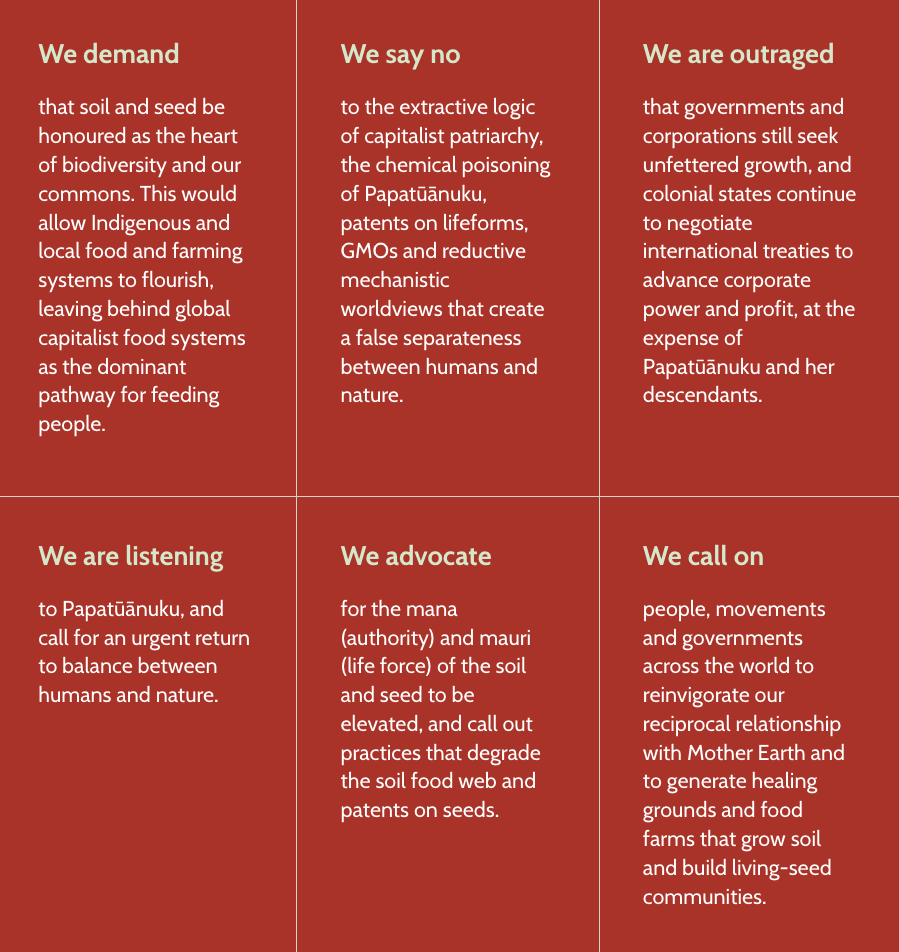
Credit: https://www.papawhakaritorito.com/mana-wahine-declaration-for-hineahuone-signing-page
This kaupapa is grounded in Te Ao Māori and as a primarily Tangata Tiriti organisation it is a huge privilege for Kaicycle to sign and tautoko (support) this important document. For us, this Declaration and Hua Parakore growing practices are an important step in honouring Te Tiriti o Waitangi and uplifting indigenous kai practices.
Te Tiriti has not been honoured. The global systems we are a part of have failed to recognise Indigenous values, law, rights, interests and tenures. For many of us tauiwi (non-Māori), these systems are webs of our ancestors’ weaving. We are not responsible for what our ancestors did. We are, however, responsible for what we do now.
As Miriama Cribb (Te Ātihaunui-ā-Pāpārangi, Ngāti Pikiao, Ngāti Porou, Ngāti Tama), Jason Mika (Tūhoe, Ngāti Awa, Whakatōhea and Ngāti Kahungunu) and many other Māori thought leaders argue, prioritising Indigenous values, law and knowledge “is not just about replacing one dominant discourse (non-Indigenous) with control for another (Indigenous), but rather allowing Indigenous people to engage and reconnect with their own knowledge systems. In doing so, [Indigenous people] encourage us all to fundamentally change how we see and therefore treat [Others], embedded in Indigenous knowledge systems.”
At Kaicycle, one of our community farm managers, Rose (Pākehā), describes Hua Parakore as “a holistic and interconnected framework that asks us to deeply reflect on the six pou and how we embody these, both spiritually and practically.” Grounded in Te Ao Māori, the Hua Parakore framework offers the following six pou that guide our māra practices and decision making.
Whakapapa
Thoughtful and discerning sourcing of inputs such as kākano (seeds) and materials that contact our oneone (soil).
Wairua
Creating a safe and peaceful space for all, enabling and empowering our communities to participate in mahi māra (gardening).
Mana
Being strong and thoughtful allies and using our resources and platforms to challenge injustice.
Māramatanga
Viewing nature as our teacher and working with open minded observation.
Te Ao Tūroa
Working with and understanding the interconnections of systems. Collaborating with the processes of growth and decay.
Mauri
Using practices that enhance the life force of our oneone (soil) and whenua (land), regenerating rather than depleting these life-giving ecosystems.
According to the Declaration’s authors, “[t]wo fundamental laws of nature serve as guiding principles for our resistance and restoration; these are the Indigenous Māori concepts of Mauri and Whakapapa.” Each month, we will reflect on one of the Declaration’s calls to action along with one of the Hua Parakore pou, beginning with Whakapapa and closing with Mauri. We hope you will join us in amplifying the Declaration’s call to “stand in our mana knowing we are doing everything possible to ensure we are each entitled to enough to be well, no more no less.”
** Feeling inspired? Check out these awesome groups and actions you can take! **